


Overview
Why the 2GB variant is the scalable choice
While the 4GB model is built for multitasking and desktop-like experiences, the 2GB RAM / 16GB eMMC model is the definitive version for production-ready efficiency:
- Optimized Performance: 2GB of LPDDR4 RAM provides ample headroom for dedicated Linux containers, Python-based logic, and optimized Machine Learning models without unnecessary power draw.
- Cost-Efficient Deployment: The ideal solution for scaling projects from prototype to production where resource management and unit cost are critical.
- Reliable Edge Intelligence: Perfect for single-purpose industrial gateways or dedicated “smart” nodes that require 24/7 stability and a compact memory footprint.
- Integrated High-Speed Storage: The 16GB eMMC ensures fast boot times and more reliable data handling than traditional SD cards.
Dual-Brain architecture: the best of both worlds
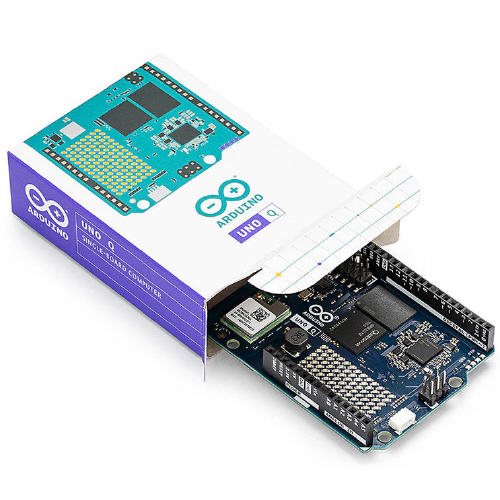
The UNO Q 2GB features a unique “Split-Processing” design that allows you to manage tasks exactly where they belong:
- The High-Level Brain (MPU): Powered by the Qualcomm® Dragonwing™ QRB2210 (Quad-core 64-bit ARM® Cortex®-A53). It runs a full Debian Linux environment, perfect for AI frameworks, secure networking, and complex data orchestration.
- The Real-Time Brain (MCU): Powered by the STM32U585 (Cortex®-M33). It manages I/O, sensors, and time-critical hardware tasks with the legendary reliability and low-latency of the Arduino ecosystem.
The Arduino app lab: your bridge to innovation
Included with the UNO Q 2GB is the Arduino App Lab, a next-gen software suite designed to unify your development experience:
- Visual Bridge: Effortlessly manage communication between the Linux OS (MPU) and the Arduino hardware (MCU).
- One-Click AI: Deploy pre-trained machine learning models directly to the Qualcomm AI engine.
- Real-Time Dashboard: Monitor system health, CPU load, and pin status via a sleek, web-based interface.
- Remote Management: Perform Over-the-Air (OTA) updates for both firmware and Linux packages.
Applications & use cases
- Industrial IoT Gateway: Securely aggregate and process sensor data locally before syncing with the cloud.
- Dedicated Edge AI: Efficient object detection, environmental monitoring, or pattern recognition for specialized hardware.
- Smart Building Hubs: Act as the central brain for lighting, security, and climate control systems.
- Advanced Robotics: Use Linux for high-level logic while the STM32 handles precision motor control and sensor fusion.
Tech specs
| Microprocessor (MPU) | Qualcomm Dragonwing™ QRB2210: Quad-core Arm® Cortex®-A53 @ 2.0 GHz Adreno GPU 3D graphics accelerator 2x ISP (13 MP + 13 MP or 25 MP) @ 30 fps |
| Microcontroller (MCU) | STM32U585 Arm® Cortex®-M33 up to 160 MHz 2 MB flash memory 786 KB SRAM |
| RAM | 2GB LPDDR4 |
| Power Supply | From USB-C connector 5 V max at 3 A Input Voltage (VIN): 7-24 V |
| Storage | 16GB eMMC |
| USB | 1× USB-C port with host/device role switching, power role switch and video output |
| Connectivity | Wi-Fi® 5 2.4/5GHz with onboard antenna Bluetooth® 5.1 with onboard antenna |
| Interfaces | I2C/I3C SPI PWM CAN UART PSSI GPIO JTAG ADC |
| Video | Video output support via USB-C MIPI DSI pins on JMEDIA header |
| Extra | 4× RGB user-controllable LEDs 8×13 Blue LED Matrix 1x Qwiic connector voltage 3V3, I2C 1x User push-button JCTL: MPU Remote Debug connector |
| Audio | Microphone IN / Headphone OUT / Line OUT on JMISC |
| Dimensions | 68.85 mm x 53.34 mm (UNO form factor) |
| MPU Operating System | Linux Debian OS with upstream support |
| Real-time Operating System | Arduino Core on Zephyr OS |
| Containerization | Docker and Docker Compose support |
| Support Operating Systems for Arduino App Lab | Windows: Windows 10 or later (64-bit) macOS: macOS 11 or later (64-bit) Linux: Ubuntu 22.04 or later, and Debian Trixie (64-bit) |







Valoraciones
No hay valoraciones aún.